
€174.00
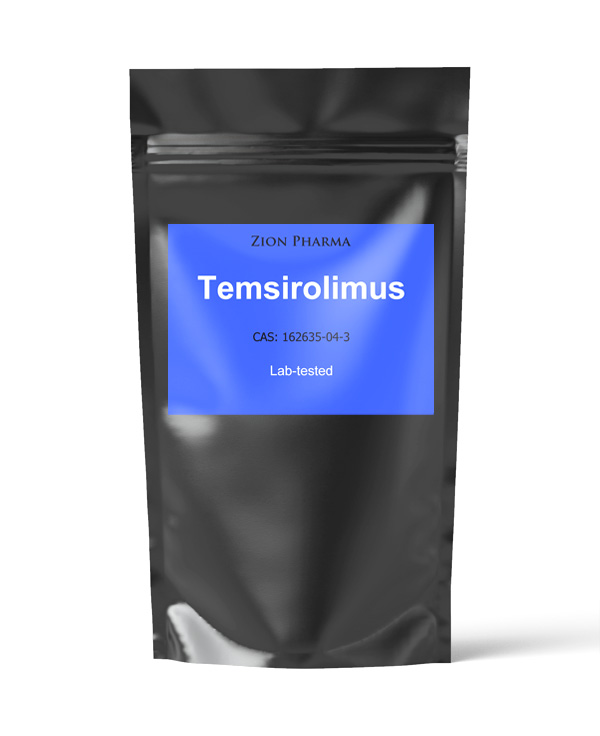
Temsirolimus
We store our Temsirolimus at about -15°C.
SKU: temsirolimus
ACTIVE INGREDIENT: Temsirolimus
OTHER NAMES: CCI 779; CCI-779; 42-(3-hydroxy-2-(hydroxymethyl)-2-methylpropanoate); temsirolimus; Torisel
APPEARANCE/COLOUR: white crystalline powder
CAS NUMBER: 162635-04-3
ATC CODE: L01EG01
FORMULA: C56H87NO16
MOLAR MASS: 1030.3 g·mol−1
ELIMINATION HALF-LIFE: 17.3 hours
QUANTITY PER PACK: 100 milligrams
STORAGE: Long-term storage recommended at about -15°C. Short-term storage recommended at 2-8°C, away from direct sunlight and heat sources, in original sealed container. Keep out of reach of children.
SCOOPS: A micro spoon is NOT added to Temsirolimus.
For precise measurement, we recommend using a laboratory scale.
The product is not intended for human use. For collectors, hobbyists, education and research.
All information provided here is for informational purposes only and may contain inaccuracies. These products are intended for collectors, hobbyists, and for educational and research purposes only. Not for use by humans or animals.
Temsirolimus is the Pruner of Wild Growth, the inhibitor of the infinite. The patient entity that whispers “enough” to the cells that have forgotten how to listen, that have mistaken their own rampant expansion for life itself.
It is the gentle, unfathomably precise hand that reaches into the very heart of the cellular machine, the mTOR nexus, and turns down the dial. It is the inhibitor of the infinite, the reminder that life is not about unchecked proliferation, but about elegant, purposeful form. It is the wisdom that a garden, to be beautiful, must be pruned; that a river, to be powerful, must have banks. It does not seek to destroy the wild, growing thing, but to teach it the sacred art of pause, of autophagy, of recycling. It is the catalyst for a cellular renaissance, where the old and damaged parts are cleared away to make space for what is functional and whole. It is the hope that even the most stubborn, misguided growth can be guided back toward harmony.
It instructs the runaway processes of growth: “Your vigor is acknowledged, but must be channeled. Remember the cycle. Remember to clear the old to make way for the new. Remember that to live long is to learn when to rest.”
As a prodrug, it is rapidly converted in vivo to its active metabolite, sirolimus (rapamycin). Its primary target is the mTOR (mechanistic Target of Rapamycin) kinase, specifically the mTORC1 complex. It binds to the FKBP-12 protein, and this complex then directly inhibits mTORC1 signaling. This inhibition halts the cell cycle at the G1 phase, preventing protein synthesis and cellular proliferation. It is a cytostatic agent, not necessarily cytotoxic; it tells cells to stop dividing, not to die.
Temsirolimus is approved for the treatment of advanced renal cell carcinoma (RCC). In a pivotal clinical trial, it demonstrated a statistically significant improvement in overall survival (10.9 months vs 7.3 months for interferon-α) and progression-free survival.
It is not a vague “life force” inhibitor. The Materialist’s Anchor, it is a specific, macrolide molecule that physically occupies a site on the FKBP-12 protein, inducing a conformational change that allows this complex to dock with and sterically hinder the mTORC1 complex, a master regulator of cell growth. The “pruning” is the direct, stoichiometric interruption of a phosphorylation cascade.
As an mTOR inhibitor, it increases the risk of infections, which is not to be disregarded; prophylactic antibiotics may be required. Occasionally, it is capable of inducing hyperglycemia and dyslipidemia (elevated triglycerides and cholesterol), requiring close monitoring and management. A serious side effect is interstitial lung disease (ILD), it is, however extremely rare and while dangerous, is typically early discovered and properly managed.
Longevity promotion is its most revolutionary off-label potential of temsirolimus. As a direct mTOR inhibitor, it is the leading pharmacological candidate to mimic caloric restriction and extend healthspan. The Dog Aging Project is the most famous real-world test of this hypothesis.
As it turns out, mTOR hyperactivation is a feature of Alzheimer’s and Parkinson’s. Pre-clinical studies show temsirolimus/rapamycin can clear toxic protein aggregates and restore cognitive function in mouse models.
By putting the brakes on immune cell proliferation and the overzealous tissue repair that leads to fibrosis, it’s being explored for conditions like scleroderma and IPF (Idiopathic Pulmonary Fibrosis).
A landmark 2009 study in Nature showed that rapamycin extended the median and maximum lifespan of genetically heterogeneous mice, even when treatment was started late in life (600 days old). This was a paradigm-shifting result, proving that a pharmacological intervention could extend lifespan in mammals, not just delay age-related disease.