Description
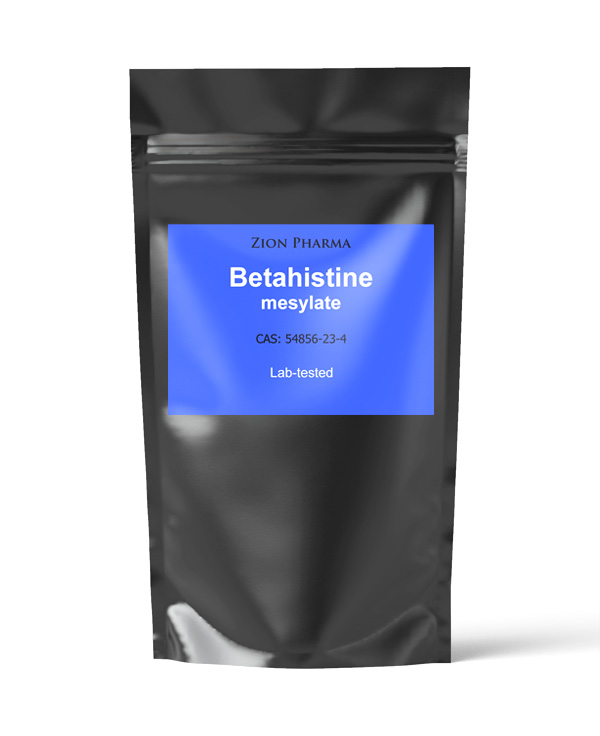
Betahistine mesylate
SKU: betahistine-mesylate
A micro spoon is added to Betahistine mesylate (0.025 ml) = 25 ml (approximately).
For precise measurement, we recommend using a laboratory scale.
The product is not intended for human use. For collectors, hobbyists, education and research.
Betahistine is a histamine-like drug primarily used to treat Ménière’s disease and other vestibular disorders by improving blood flow in the inner ear and modulating histaminergic neurotransmission. It has also been prescribed in tinnitus, migraine, and cluster headaches. As a weak H₁ receptor agonist, it improves vasodilation, yet, its particularly interesting effects are linked to its action as a strong H₃ receptor antagonist. While H₃ receptors act as autoreceptors in presynaptic histaminergic neurons and control histamine turnover by feedback inhibition of histamine synthesis and release, their scope of action is anything but limited to histamine. It has also been demonstrated to presynaptically inhibit the release of a number of other neurotransmitters including, but probably not limited to dopamine, GABA, acetylcholine, noradrenaline, histamine and serotonin. Conversely, as its antagonist, betahistine contributes to their increased release, most notably histamine, acetylcholine, dopamine, and norepinephrine, which amounts to its nootropic potential.
Preclinical studies suggest that histamine enhances long-term potentiation (LTP) and neuroplasticity. H₃ knockout mice perform better than controls at tasks engaging working memory. Furthermore, betahistine was found to enhance cholinergic neurotransmission in rats.
Moreover, some data indicates that it may reduce cortical spreading depression (CSD), a wave of electrophysiological hyperactivity followed by a wave of inhibition (disrupting neuronal activity and leading to a period of reduced electrical activity), associated with conditions such as migraine with aura, traumatic brain injury, and stroke.
It is currently believed that betahistine might counteract the cognitive decline in Alzheimer’s, and possibly other dementias of cortical etiology, as preliminary research implicates the pro-cognitive role of histaminergic system and its modulation — further investigation and human trials, are, however, essential to corroborate this hypothesis. Betahistine has also been studied as adjunctive treatment for Parkinson’s, for its potential to address balance and cognitive symptoms.
Evidence suggests that H₃ antagonists improve sustained attention in rodent models. Given their ability to raise dopamine and norepinephrine levels in prefrontal cortex, potentially improving attention, memory, and executive function, betahistine would also make a natural candidate drug for the treatment of ADHD. While this area remains to be researched, anecdotal reports generally support this theoretical premise. It is definitely worth mentioning that betahistine would have a major advantage over stimulant medication, as it is unlikely to cause anxiety or insomnia at typical doses.
A potent H₃ antagonist might also succeed at alleviating the cognitive symptoms of schizophrenia; a more speculative line of thought posits that histaminergic modulation may influence mood, outlining novel avenues of research to be explored to assess the impact of drugs like betahistine on the symptoms of major depressive disorder.
A 2018 small study found that betahistine improved reaction time in healthy adults, a result that could be attributed to H₃ effects.