Description
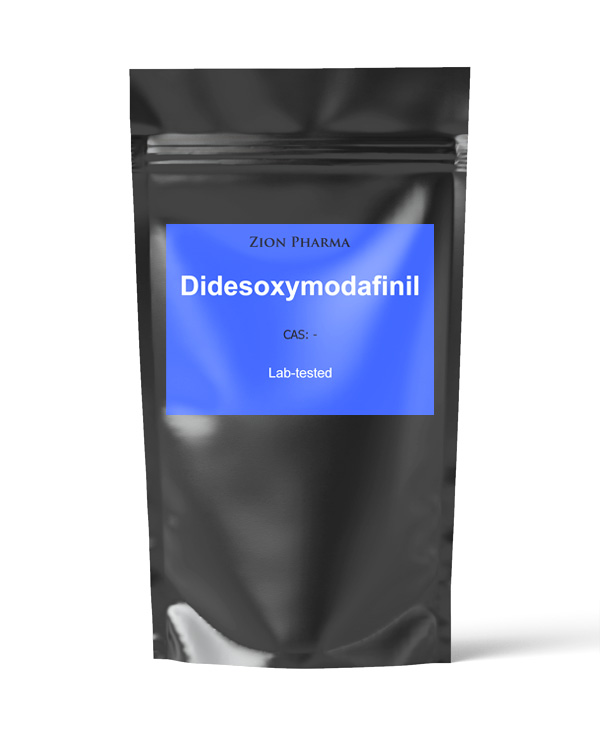
Didesoxymodafinil (Modafinil analogue)
SKU: didesoxymodafinil
A micro spoon is added to Didesoxymodafinil (0.15 ml) = 30 mg (approximately).
For precise measurement, we recommend using a laboratory scale.
The product is not intended for human use. For collectors, hobbyists, education and research.
Didesoxymodafinil is a direct analogue of modafinil. While the chemical structure of the latter is 2-[(diphenylmethyl)sulfinyl]acetamide, the former didesoxymodafinil differs in two key ways: it lacks the sulfoxide oxygen atom (it has a sulfur-carbon bond instead of a sulfur-oxygen double bond), and it lacks the terminal acetamide group, replaced by a simple ethylamine chain.
Those changes made it a simpler, potentially more lipophilic (fat-soluble) molecule, to which it owes its superior bioavailability relative to that of modafinil, which it surpasses by impressive 20%. Its, increased lipophilicity leads to faster brain penetration. While this particular property could be expected to shorten its action, animal studies suggest otherwise. In a dog study, it shortened wakefulness latency by 68% time than modafinil and laster longer.
Compared to its “founding compound”, didesoxymodafinil’s selectivity as dopamine reuptake inhibitor (DAT) is greater – as evidenced in studies in cell models, approximately two-fold. Rat studies show that while its administration resulted in a 150% increase in extracellular dopamine concentration in the striatum, effects on other monoamine neurotransmitters were negligible.
Unlike modafinil, didesoxymodafinil exhibits weaker affinity for OX1R and OX2R orexin receptors. Interestingly enough, in studies using transgenic orexin-deficient mice, it maintained approximately 60% efficacy in promoting wakefulness, which suggests an orexin-independent mechanism of action.
Didesoxymodafinil has also been found to possess some effects on adenosine receptors, being a weak antagonist of A1 and A2A receptors, which may contribute to its stimulant effects, albeit to a limited extent relative to modafinil or caffeine. Without the amide, it may have a less pronounced histaminergic effect (which contributes to modafinil’s wakefulness), placing more emphasis on the dopaminergic component.
Moreover, animal studies led to the discovery of other interesting properties of the compound in question. It has been found to improve spatial memory in rats after mere 3 days of administration, allowing the animals to reach the target 40% faster than controls. As it turns out, didesoxymodafinil happens to possess considerable neuroprotective properties, as it has been to proven protect against brain ischemia in rat models, reducing its scope by 35%. The mechanism of action behind this finding might be linked to the activation of the PI3K/Akt pathway and enhanced expression of anti-apoptotic proteins.
As for its subjective effects, their profile seems to resemble those of modafinil and flmodafinil, placing didesoxymodafinil somewhere in the middle ground between those two. Compared to modafinil, it feels less energizing and its effects on mood are rather subtle. On the other hand, its wakefulness and focus might be described as sharper and more hyperfocus-like vs. the effects produced by flmdafinil. As such, it is not very likely to encourage physical activity, but could be a useful study aid as a “non-distracting” stimulant.
It has to be emphasized that didesoxymodafinil was never studied in humans. As such, risks associated with its use remain potentially unknown. It is strongly advised to approach this substance with caution.