Description
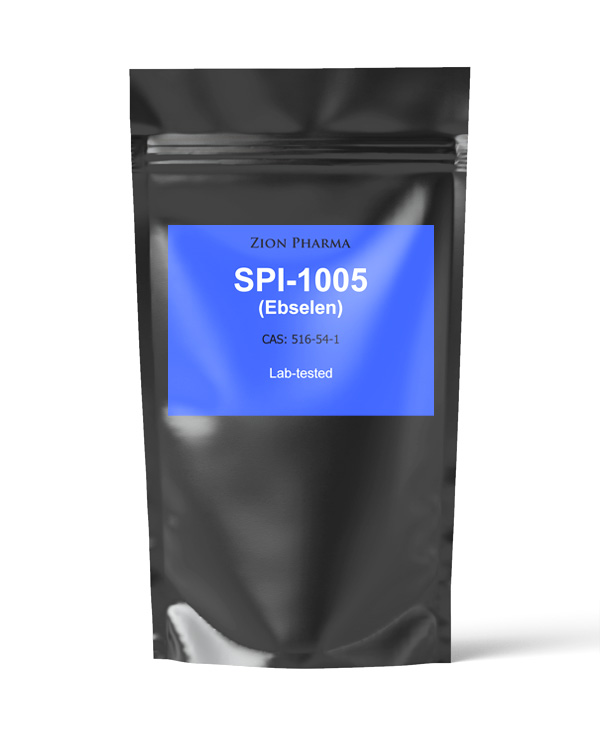
SPI-1005 (Ebselen)
SKU: ebselen
A micro spoon is added to SPI-1005.
For precise measurement, we recommend using a laboratory scale.
The product is not intended for human use. For collectors, hobbyists, education and research.
Ebselen, also known as SPI-1005 is an organoselenium compound with significant antioxidant, neuroprotective, cytoprotective, antitumor, and antibacterial properties, currently investigated for the treatment and prevention of hearing loss, Meniere’s disease, tinnitus, severe acute respiratory syndrome coronavirus 2 (SARS-CoV-2) and as an add-on treatment for bipolar disorder and treatment-resistant depression (TRD).
First synthesized by Lesser and Weiss in 1924, it wasn’t until the early 1980s when its pharmaceutical potential as a glutathione peroxidase (GPx) mimetic was recognized. It mimics glutathione peroxidase by catalyzing the reduction of harmful peroxides, using glutathione as a cofactor. Its mechanisms of action go beyond that, as it is also able to induce glutathione peroxidase, strengthening the cell’s natural antioxidant defenses.
By reducing oxidative stress, ebselen protects the cochlea’s outer hair cells (OHC) from apoptosis—an effect critical for hearing preservation, given that those cells are incapable of regeneration. Through the inhibition of lipoxygenase and cyclooxygenase pathways, ebselen exerts its anti-inflammatory action, further protecting the inner ear from tissue damage.
Ebselen has been demonstrated to reduce cerebral infarction volume and improve behavioral outcomes in stroke models, combating ischemia-reperfusion injury through its antioxidant activity. Some studies suggest that using ebselen together with a low dose of tissue plasminogen activator (tPA) may help protect the brain and lower the risk of bleeding that can happen with higher doses of tPA.
Ebselen has also shown potential in protecting spinal cord tissue by lowering harmful substances like malondialdehyde (MDA) and stopping the decrease of antioxidant enzymes such as superoxide dismutase (SOD). In Parkinson’s disease models, it has been found to counteract neuronal loss by reducing oxidative stress induced by toxins like MPP+ and regulating apoptosis-related proteins (Bcl – 2/Bax). Moreover, ebselen offers neuroprotection by modifying the redox site of the NMDA receptor, helping maintain cellular viability under stress and protecting against excitotoxicity.
What is more, ebselen acts as an inhibitor of inositol monophosphatase (IMPase), a mechanism thought to be largely responsible for the mood-stabilizing effects of lithium. By reducing the glutamate/glutamine (Glx) ratio, it could potentially address glutamatergic dysfunction implicated in depression. Its capacity to lower inositol and glutamine/glutamate (Glx) levels in the human anterior cingulate cortex (ACC) was confirmed by research utilizing magnetic resonance spectroscopy (MRS), while studies in healthy volunteers found that ebselen facilitates the recognition of positive emotions, believed to be a predictor of antidepressant efficacy.
Moreover, it has been found to produce effects on the serotonin system akin to those of lithium and decrease behavioral impulsivity in animal experimental studies. Neuropsychological studies speak in favor of ebselen’s antidepressant profile, considering its effects on emotional processing and reward seeking. While ebselen has been demonstrated to lower a human laboratory measure of impulsivity in a manner similar to lithium, which is considered relevant for suicide prevention in mood disorders, ebselen’s efficacy in that regard in clinical populations remains unknown.
In numerous studies, ebselen has displayed impressive anti-cancer effects, interfering with tumor growth, invasion, and survival by targeting several key molecular processes in cancer cells.