Description
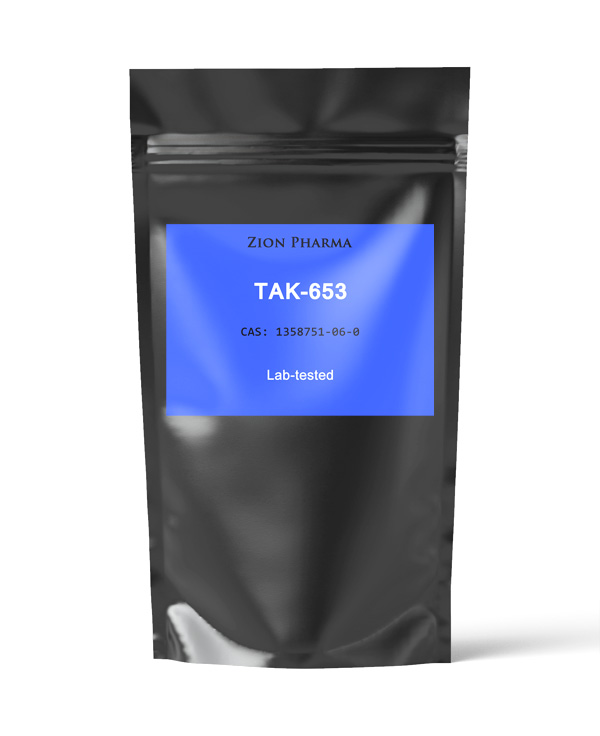
TAK-653 (osavampator)
SKU: tak-653
A micro spoon is NOT added to TAK-653.
For precise measurement, we recommend using a laboratory scale.
The product is not intended for human use. For collectors, hobbyists, education and research.
TAK-653, also known as osavampator and NBI-1065845, is a novel experimental drug being investigated as a treatment for treatment-resistant depression, developed by Takeda Pharmaceuticals. Due to its marked nootropic effects, it has attracted the attention of neurohackers, who perceive it as one of the most potent nootropics up to date.
As a highly selective positive allosteric modulator (PAM) of the AMPA receptor, TAK-653 acts as its highly selective potentiator (a subclass of iGluR modulators). In contrast to older AMPAkines, TAK-653 does not lead to receptor desensitization, which could explain its less severe side effects. By reducing the rate of receptor desensitization and internalization, osavampator and other AMPA PAMs enhance the effects of agonists at the AMPA receptor’s primary site. The antidepressant effects of ketamine and other NMDA receptor antagonists may be due in large part to their ability to activate the AMPA receptor, which in turn activates mTOR and upregulates brain-derived neurotrophic factor (BDNF). The action of osavampator on AMPA receptor-mediated transcription is enhanced by its ability to magnify the impact of endogenous glutamate on the receptor. Its improved binding affinity and functional selectivity set it apart from other AMPAkines such aniracetam and CX-516, Through enhanced BDNF signaling, it indirectly encourages the development of new neurons. With improved synaptic plasticity, long-term potentiation (LTP) can take place without excessive stimulation. It is believed to reduce excessive inhibition (important in depression and cognitive impairment) through modification of the glutamate-GABA balance. Unlike NMDA-targeting medications, it is not associated with the risk of excitotoxicity (unlike NMDA-targeting medications) and does not involve direct agonism.
Its pro-cognitive potential became apparent in preclinical models, where substantial working memory and executive function improvements were noted. Preliminary research identified additional effects of TAK-653, particularly beneficial for neurodivergent individuals: improved impulsivity and sustained attention, likely via prefrontal AMPA modulation. Human trials suggest enhanced pattern separation (critical for learning) and faster information processing. Phase I/II trials conducted by Takeda Pharmaceuticals documented pro-cognitive effects of TAK-653 at 1-3 mg/day, with prominent episodic memory enhancement. As a candidate drug for treatment-resistant depression, it showed rapid-onset antidepressant effects (within days, unlike SSRIs) on par with ketamine, albeit more predictable and presumably safer. Additionally, animal studies suggest its strong neuroprotective profile, as it has been demonstrated to reverse scopolamine-induced memory deficits and prevent glutamate excitotoxicity. Furthermore, it is speculated that osavampator might delay the onset of neurodegenerative disorders and alleviate their course by counteracting synaptic weakening.
Whereas TAK-653 was initially assumed to be a potential antidepressant without psychotomimetic effects due to lack of locomotor hyperactivity in rats, a subsequent study that examined the safety and CNS stimulatory effects of this compound in humans found that, while the drug’s effects were not as strong as those of other psychostimulants, it did seem to have some stimulant-like properties. That said, no serious side effects were noted.
Anectodal reports consistently mention smooth, strictly mental stimulation, easily sustained attention with “laser focus” quality, which, however, feels more natural and less forced than the effects of traditional CNS stimulants. Its headspace is characterized by lucidity, wakefulness, and optimal stimulation level, doesn’t result in a “tired, but wired”, jittery feeling, and seems overall “cleaner” than those of racetams or modafinil. According to certain online accounts, TAK-653 users experience remarkable analysis enhancement and unparalleled mental precision and “sharpness” that facilitates complex problem solving and makes thought processes “seamless”. Consequently, even relatively demanding tasks do not require effortful concentration, mental stimulation is readily associated with and a sense of accomplishment, and one is motivated to seek intellectual pleasure. Improved verbal fluency is another commonly reported effect of TAK-653. While mood brightening observed with this osavampator is relatively mild, it seems to promote emotional stability and neutralize the negative bias, potentially counteracting cognitive distortions in depression.
It would be no overstatement to call TAK-653 a nootropic par excellence. Indeed, its outstanding capacity to affect “core” parameters of cognition that basically amount to fluid intelligence, often thought to be as virtually immutable if not predetermined, situates it among the very elite of nootropics. Particularly impressive is the fact that the said “raw computational power enhancement” is achieved in healthy individuals, transcending the limitation defined by baseline rather than correcting preexisting deficits. Given its brief history, TAK-653 likely possess other properties beneficial for the central nervous system and mental agility that are yet to be identified throughout the years to come, it seem a true rising star in the nootropic galaxy.