
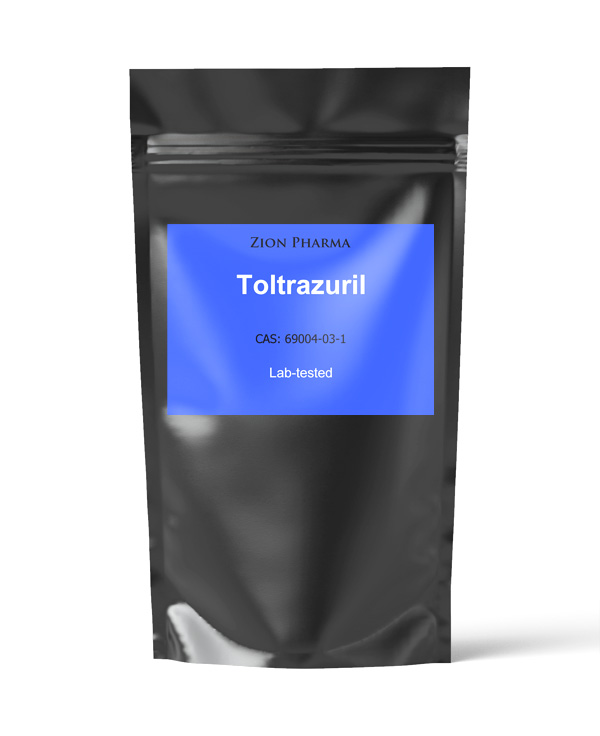
Home > Shop > Toltrazuril

Toltrazuril

€17.00

Toltrazuril is a triazine-based antiprotozoal drug, primarily used in veterinary medicine to treat coccidiosis in animals, coccidiosis, a parasitic disease caused by coccidia, microscopic, spore-forming, single-celled obligate intracellular parasites belonging to the apicomplexan class Conoidasida. It is the prodrug of ponazuril and works by disrupting protozoal mitochondrial electron transport and folate metabolism.

While tonazuril is not FDA-approved for human use, its mechanism of action and effects on parasitic infections have led to some speculative and experimental off-label applications, particularly in neurology and psychiatry.

Recent pharmacological research suggests that tonazuril might possess some nootropic properties of their own. A project aimed at identification of small molecules with a stimulatory effect on BDNF and NGF as a direction explored in signaling in search for novel treatment options for Alzheimer’s disease, depression, possibly other psychiatric conditions and disorders characterized by cognitive impairment, found toltrazuril to be a positive allosteric modulator of Trk receptors. It demonstrated pro-cognitive effects in various preclinical in vivo models in mice. Cognitive enhancement was also seen in age-related decline in memory. Furthermore, studies in rodents suggest that toltrazuril might display anti-depressant-like effects, as evidenced by the forced swim test model.

Toxoplasmosis, caused by theToxoplasma gondii parasite, is estimated to infect 30-50% of the world’s population. Its prevalence varies significantly by region, and while in the United States it is believed to occur in around 11%, in some European countries it can affect as much as 90% people. It has been linked to psychiatric disorders (schizophrenia, bipolar disorder) and neurodegenerative conditions. Tonazuril’s ability to cross the blood-brain barrier (BBB) makes it a candidate for mitigating chronic Toxoplasma-related neuroinflammation. Anecdotal reports suggest improvements in brain fog, fatigue, and cognitive dysfunction in patients with suspected chronic parasitic infections.

Toxoplasma gondii alters dopamine and GABA pathways in the brain. Some neurodivergent individuals (particularly those with autism or ADHD) exhibit immune dysregulation, chronic infections, or elevated Toxoplasma antibodies. In such cases, antiprotozoals might help if an underlying infection exacerbates symptoms. By eliminating the parasite, toltrazuril might restore normal neurotransmission in affected individuals. No direct studies exist, however, on toltrazuril’s neuromodulatory effects beyond antiprotozoal action. Anecdotal reports suggest some children with autism and confirmed parasitic infections show behavioral improvements after antiprotozoal treatment, but controlled studies are lacking.

Toltrazuril’s safety profile in humans is not well-established, though related drugs (i.e., nitazoxanide) are generally well-tolerated.

SKU: toltrazuril Category:
SKU

toltrazuril

ACTIVE INGREDIENT:

Toltrazuril

ADDITIONAL INGREDIENTS:

–

OTHER NAMES:

Baycox; Tolcox; BAY i 9142; BAY i-9142; BAY-i 9142; 1,3,5-Triazine-2,4,6(1H,3H,5H)-trione, 1-methyl-3-(3-methyl-4-(4-((trifluoromethyl)thio)phenoxy)phenyl)-

CAS NUMBER:

69004-03-1

ATCvet CODE:

QP51BC01; QP51BC51

FORMULA:

C18H14F3N3O4S

MOLAR MASS:

425.38 g·mol−1

ITEM TYPE:

powder

QUANTITY PER PACK:

1 gram

STORAGE:

Best store in a cool and dry place (0-6°C). Keep away from direct sunlight and heat. Keep out of reach of children.

Description

Toltrazuril

SKU: toltrazuril

A micro spoon is added to Toltrazuril (0.5 ml) = 250 mg (approximately).

For precise measurement, we recommend using a laboratory scale.

The product is not intended for human or animal use. For collectors, hobbyists, education and research.

Toltrazuril is a triazine-based antiprotozoal drug, primarily used in veterinary medicine to treat coccidiosis in animals, coccidiosis, a parasitic disease caused by coccidia, microscopic, spore-forming, single-celled obligate intracellular parasites belonging to the apicomplexan class Conoidasida. It is the prodrug of ponazuril and works by disrupting protozoal mitochondrial electron transport and folate metabolism.

While tonazuril is not FDA-approved for human use, its mechanism of action and effects on parasitic infections have led to some speculative and experimental off-label applications, particularly in neurology and psychiatry.

Recent pharmacological research suggests that tonazuril might possess some nootropic properties of their own. A project aimed at identification of small molecules with a stimulatory effect on BDNF and NGF as a direction explored in signaling in search for novel treatment options for Alzheimer’s disease, depression, possibly other psychiatric conditions and disorders characterized by cognitive impairment, found toltrazuril to be a positive allosteric modulator of Trk receptors. It demonstrated pro-cognitive effects in various preclinical in vivo models in mice. Cognitive enhancement was also seen in age-related decline in memory. Furthermore, studies in rodents suggest that toltrazuril might display anti-depressant-like effects, as evidenced by the forced swim test model.

Toxoplasmosis, caused by theToxoplasma gondii parasite, is estimated to infect 30-50% of the world’s population. Its prevalence varies significantly by region, and while in the United States it is believed to occur in around 11%, in some European countries it can affect as much as 90% people. It has been linked to psychiatric disorders (schizophrenia, bipolar disorder) and neurodegenerative conditions. Tonazuril’s ability to cross the blood-brain barrier (BBB) makes it a candidate for mitigating chronic Toxoplasma-related neuroinflammation. Anecdotal reports suggest improvements in brain fog, fatigue, and cognitive dysfunction in patients with suspected chronic parasitic infections.

Toxoplasma gondii alters dopamine and GABA pathways in the brain. Some neurodivergent individuals (particularly those with autism or ADHD) exhibit immune dysregulation, chronic infections, or elevated Toxoplasma antibodies. In such cases, antiprotozoals might help if an underlying infection exacerbates symptoms. By eliminating the parasite, toltrazuril might restore normal neurotransmission in affected individuals. No direct studies exist, however, on toltrazuril’s neuromodulatory effects beyond antiprotozoal action. Anecdotal reports suggest some children with autism and confirmed parasitic infections show behavioral improvements after antiprotozoal treatment, but controlled studies are lacking.

Toltrazuril’s safety profile in humans is not well-established, though related drugs (i.e., nitazoxanide) are generally well-tolerated.

Additional information

Weight