Description
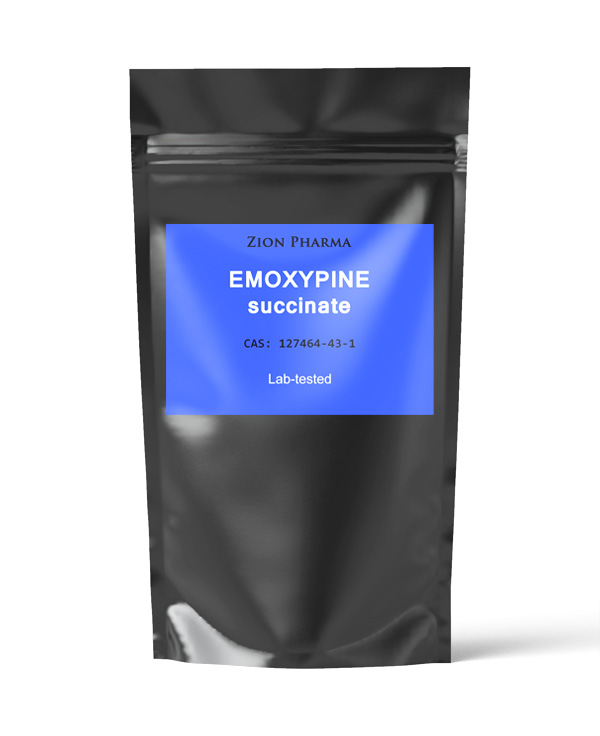
Emoxypine succinate salt
SKU: emoxypine
For precise measurement, we recommend using a laboratory scale.
The product is not intended for human use. For collectors, hobbyists, education and research.
Emoxypine (2-ethyl-6-methyl-3-hydroxypyridine), commonly made available as succinate salt, and as such also known as Mexidol or Mexifin, is a derivative of pyridoxine, one of the forms of vitamin B6.
It has recently gained popularity as a nootropic, anxiolytic, neuroprotective agent, antioxidant and actoprotector.
As an antioxidant, it protects the neurons from free radicals induced damage by increasing the activity of antioxidant enzymes, such as superoxide dismutase and glutathione peroxidase, as well as by inhibiting the synthesis of prostaglandins, which accounts for its anti-inflammatory effects. It also exerts its neuroprotective actions by increasing cerebral blood flow, decreasing the viscosity of brain cell membranes, thus enriching their phosphatidylserine and phosphatidylinositol levels. Emoxypine succinate has also proven anti-ischemic, and anti-hypoxic properties.
As an anxiolytic, the effects on emoxypine succinate are rather subtle, yet, by no means, weak. For example, someone with social anxiety might not be filled with self-confidence upon the ingestion of the drug before a meeting, but then they would observe their own behavior and feelings, just to conclude how natural and at ease they had been.
Subjectively, though, it bestows the user upon relatively mild, calming and soothing effects which are not accompanied by somnolence, sedation or a feeling of intoxication, which makes it a convenient aid in stress- and restlessness-reduction as one goes about their day-to-day activities. People with mild mood or anxiety disorders might find complete relief from their symptoms with this drug.
The observation that emoxypine succinate increases binding interaction at GABA-benzodiazepine receptor complex, enabling GABA and GABA-A agonists to more readily bind to their sites seems to explain, at least partially, its anxiolytic properties.
Emoxypine succinate has also been demonstrated to possess some mood-elevating qualities, which could be partly due to its weak MAOI (monoaminoxidase inhibitor) property and subsequent modest raise in serotonin and dopamine levels, with possible anxiolytic outcome. An animal study on Parkinson’s has shown that the compound can lengthen the therapeutic effects of L-DOPA by 3-5 hours when co-administered, raising dopamine levels and its metabolites in striatum. Due to its antioxidant properties, it protects the dopaminergic neurons in substantia nigra from degeneration.
This compound has also been shown to modulate the activity NMDA receptor and AMPA, which could be vital in terms of not only cognition but also mood, as the balance of NMDA and AMPA mediated activity could be protective against glutamate excitotoxicity, recently implied in the pathogenesis of major depression.
Unlike the vast majority of anxiolytics, the drug not only doesn’t cause cognitive impairment, but also happens to have anti-amnestic properties, as numerous animal models have proven. This might be due to its modulation of the acetylcholine receptor complexes of the brain membranes by increasing their binding affinity.