


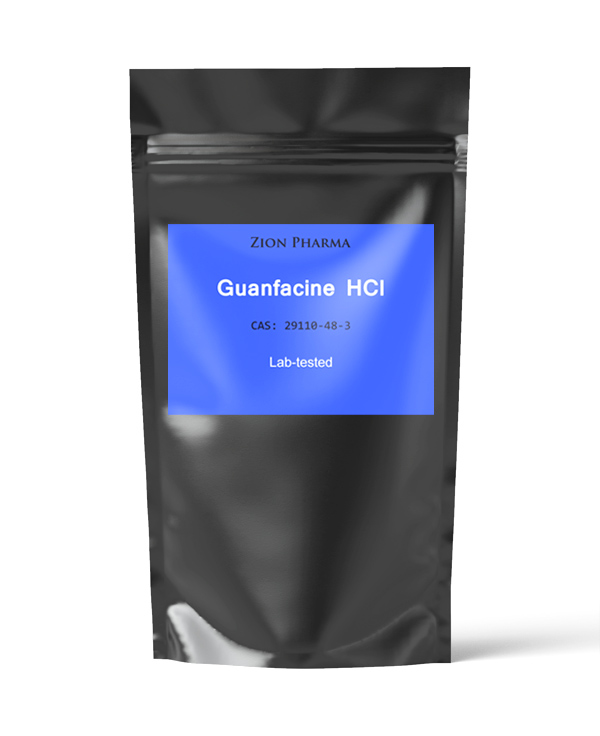
Description
Guanfacine HCl powder
SKU: guanfacine
For precise measurement, we recommend using a laboratory scale.
The product is not intended for human use. For collectors, hobbyists, education and research.
Guanfacine, a drug that belongs to a class of medications called α2a specific adrenergic receptor agonists, more commonly known as alpha agonists, had originally been introduced to the market as an antihypertensive agent. Recently, however, it has also been approved for the treatment of ADHD and represents a represents a novel approach in its pharmacotherapy. Unlike the more traditional stimulant (methylphenidate, amphetamines) and non-stimulant medications (atomoxetine, bupropion) acting mainly on catecholaminergic presynaptic mechanisms, guanfacine acts at postsynaptic level. Its mechanism of action seems to be related to the activation of 2α a-adrenergic receptors in the brain, tricking the sympathetic nervous system the autonomous system nerve into tuning down its response, which results not only in lower blood pressure, but also a a significant decrease in hyperactivity, impulsivity, insomnia, and emotional dysregulation.
By acting like anxiolytics, guanfacine and other α2A-adrenergic receptor agonists dampen the emotional responses of the amygdala and fortify the prefrontal cortex’s ability to regulate emotion, behavior, and cognition. These effects arise from both the suppression of stress-induced catecholamine release and prominent, post-synaptic actions in the pre-frontal cortex, which are believed to be mediated by the stimulation of post-synaptic α2A-adrenoceptors on dendritic spines.
Studies in monkeys have shown that guanfacine can improve working memory, attention regulation, and behavioral inhibition.
While current scientific evidence suggests that guanfacine is generally more effective than placebo in improving ADHD symptoms among those with ADHD or ASD, the most marked improvement was typically observed in the 6-12 age group. In two systematic reviews focused on children and adolescents, guanfacine was not significantly different than methylphenidate in clinician-rated symptoms, parent-rated symptoms, teacher-rated symptoms, or the ADHD-RS score.
Unlike stimulant medications, guanfacine possesses no abuse potential. Conversely, it might actually help reduce addictive behavior, including compulsive drug use (i.e., nicotine, cocaine). As such, it might be the drug of choice for ADHD patients with the history of drug addiction.
While it is generally not considered the first-line treatment, guanfacine can complement and synergistically enhance the action of stimulants, as it might aid it the facets of ADHD where stimulants do not fully succeed, such as hyperactivity, impulsivity, and self-regulation of behavior and emotions. Moreover, its calming properties make it seem to be tailored to be used to control the side effect profile of stimulant medications. It might also be the drug of choice for patience that do not tolerate stimulant medications well or those for whom they are strongly contraindicated.
The atennuating potential of guanfacine on emotional hyperreactivity has led to multiple studies exploring its applications in the treatment of post-traumatic stress disorder (PTSD). While their results are mostly inconclusive, one study reported favorable outcomes in children with comorbid ADHD. It might also be helpful for adult PTSD patients who do not respond well to selective serotonin reuptake inhibitors (SSRIs).
Guanfacine has also been researched for the treament of withdrawal symptoms from opioids, alcohol, and nicotine. Empyrical data indicates that guanfacine can diminish stress-induced cravings for nicotine in individuals attempting to quit smoking, potentially by enhancing self-control mediated by the prefrontal cortex.
It has been investigated for addressing cognitive, behavioral and emotional difficulties in conditions affecting prefrontal cortex function, such as cognitive and attention difficulties in individuals with traumatic brain injury, stroke, schiztypal disorders, and the elderly.
Lately, guanfacine is being investigated as possible treatment of long COVID.
 OUT OF STOCK